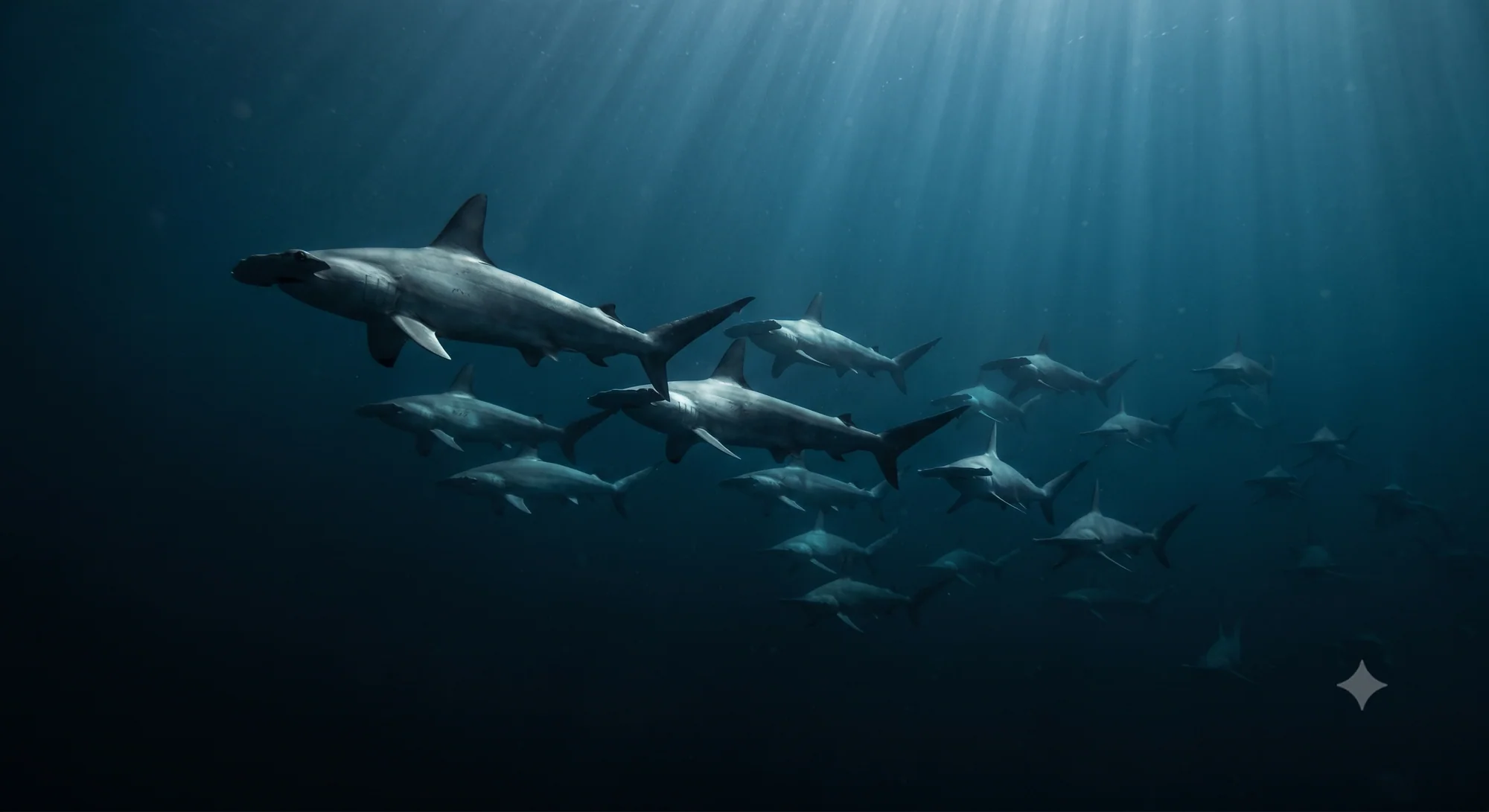
Why Sharks Matter, The Science of the Apex Predator
A 71% global population decline since 1970. Trophic cascades. The landscape of fear. Nutrient cycling across ocean zones. The case for sharks as structural components of marine ecosystems, not charismatic fauna, but the architecture the ocean depends on.
Sharks have been swimming the oceans for around 450 million years. They are older than trees. They are older than Saturn's rings and older than the North Star. They have lived through four of the five great extinctions that erased most life on Earth and carried on largely unchanged. Then, in a single century of industrial fishing, we cut their numbers further than any of those catastrophes managed.
Most people only ever meet a shark through a screen, as a fin and a silhouette under ominous music. The real animal is stranger and far more useful than the one in the films. A shark is not a swimming danger that occasionally does the ocean some good. It is a working part of the ocean that occasionally swims near a beach. Take it out and the machine does not keep running the same way.
This is an attempt to describe the animal properly. How it is built, how it hunts, how it rests, and what it quietly does for the water around it. Some of what follows is hard reading, because the science is settled and the direction is bad. But it begins with the parts people rarely hear, the parts that make a shark one of the most refined animals in the sea.
Built over 450 million years
A shark is not put together like the fish next to it on the reef. Cut one open and you will not find a single bone anywhere in its body. The whole skeleton is cartilage, the same flexible tissue in the tip of your nose. Cartilage is lighter than bone and far more bendable, which lets a shark turn inside a circle that would snap a bony fish, and costs it less to carry.
Bony fish hold their depth with a gas-filled swim bladder. Sharks have none. Instead they carry an enormous oil-rich liver that can fill up to ninety percent of the body cavity and make up a quarter of the animal's weight. Oil floats, so the liver works as a slow, passive buoy that keeps the shark from sinking without it spending any energy at all. It is also a fuel tank. On a long crossing with nothing to eat, a shark lives off its own liver.
The skin is not smooth either. It is armoured with thousands of tiny tooth-shaped scales called dermal denticles, each one ridged and angled toward the tail. Run a hand from nose to tail and it feels like glass. Run it the other way and it feels like sandpaper. Those denticles break up turbulence and let a shark slip through the water almost silently, which matters a great deal to an animal that hunts by surprise. Engineers have copied the pattern onto racing swimsuits and the hulls of ships.
Behind the head sit five to seven bare gill slits, with no hard cover over them like a bony fish has. And the teeth never run out. They sit in rows on a slow conveyor of tissue, and as the front ones chip or wear down, fresh ones rotate forward to take their place. A single shark can work through tens of thousands of teeth across its life. None of this is accidental. It is the result of 450 million years of being very good at one job.
How a shark hunts
A shark finds its prey with a stack of senses layered by distance. Each one hands over to the next as the target gets closer, and together they leave very little room to hide.
It starts with smell. Roughly two-thirds of a shark's brain is given over to processing odour, and in open water it can pick up blood or the oils of an injured fish carried on a current from a long way off. The old line about smelling a single drop of blood in a swimming pool is an exaggeration, but not by as much as you would hope.
Closer in, the lateral line takes over. This is a fluid-filled canal that runs down each flank and across the head, lined with tiny hair cells that read movement and pressure in the water. A struggling fish, or a swimmer kicking clumsily at the surface, sends out vibrations the shark can feel and follow long before it can see anything at all.
In the last few feet, sight gives way to something stranger. Scattered across the snout are hundreds of jelly-filled pores called the ampullae of Lorenzini, and they detect electricity. Every living animal leaks a faint electrical field through its muscles and nerves, and a shark can sense it down to a few billionths of a volt. That is enough to find a flatfish buried under sand, or to line up a bite in water too murky to see through. Some species roll their eyes back to protect them in the final instant and finish the strike all but blind, steering by electricity alone.
None of this adds up to a mindless eating machine. The senses are precise instruments, and most sharks are careful, selective hunters that circle, test and assess before they ever commit. The reputation for blind aggression is mostly ours, not theirs.
Do sharks sleep?
They do rest, but how they manage it depends entirely on how they breathe.
Many of the famous open-ocean species, the great whites, makos, whale sharks and most hammerheads, breathe by swimming. They push water through the mouth and over the gills by moving forward, and if they stop, they suffocate. This is where the idea that sharks never sleep comes from. They cannot lie still on the bottom. But they do not need to. The basic swimming rhythm is driven low in the spinal cord rather than the thinking part of the brain, so one of these sharks can drop into a rest state while its body keeps cruising a slow, steady line on autopilot, eyes open, going nowhere in particular.
Bottom-dwelling sharks have it easier. Nurse sharks, wobbegongs and Port Jackson sharks pump water over their gills with their cheek muscles, so they can lie motionless on the seabed and still breathe. Many also have spiracles, small openings behind the eyes that draw in clean water even while the animal rests on the sand or half buries itself in it. Divers regularly find these sharks stacked under a ledge in the middle of the day, doing absolutely nothing.
For a long time no one could say whether that stillness counted as real sleep. Recent work on Port Jackson sharks settled part of it. When the animals rest, their metabolism drops and they grow much harder to rouse, which are the signatures of genuine sleep rather than idle waiting. So yes, sharks sleep. Some of them just have to keep swimming while they do it.
The apex predator effect
Apex predators run an ecosystem from the top down. Ecologists call it top-down regulation, and what it describes is a chain of effects that flows downward through an entire food web from the animals at its peak. Take the predator out and those effects do not just stop. They run in reverse. The animals it used to eat multiply unchecked. Their food gets stripped out. Whatever fed on that expands in turn. The balance that held while the predator was present comes apart step by step, often over decades, and is extraordinarily hard to put back.
The textbook example on land is Yellowstone. Wolves were reintroduced in 1995 after a seventy-year absence, and the cascade that followed changed not just the elk and the deer but the shape of the rivers themselves, because elk that suddenly had something to fear stopped lingering to graze the young trees along the banks. The same thing happens in the sea. A review of shark-removal studies found the pattern again and again: the prey expands, its own prey collapses, and the whole system reorganises around the gap at the top.
On a coral reef the chain is short and direct. Big reef sharks eat grouper and other mid-sized predators. Those predators eat the parrotfish and surgeonfish that graze the algae which would otherwise smother the coral. Where the sharks have gone, grouper numbers have climbed in some places and eaten down the grazers, and the result is not more fish. It is algae creeping over coral that no longer has anything keeping it in check.
The landscape of fear
A shark does not have to kill anything to keep an ecosystem in order. Ecologists call it the landscape of fear, and it describes the way prey animals change their behaviour simply because a predator might be near, even when very few of them are actually caught. They steer clear of certain ground. They cut their feeding short. They stay out in open water where they can run rather than settling onto the reef to eat.
The clearest record of this comes from Shark Bay in Western Australia, where researchers watched tiger sharks and dugongs for years. When the sharks were around, the dugongs fed in the thinner, safer seagrass and left the rich deep meadows alone. When shark numbers dropped, the dugongs moved into the best pastures and grazed them down. The sharks were not eating the dugongs. They were deciding where and how the dugongs fed, and that quiet pressure kept the seagrass beds intact across the whole bay.
On reefs the same effect shows up in how the fish spread themselves out. On reefs where sharks have been fished down, reef fish behave more boldly and crowd into the richest feeding areas, and the result is patches of overgrazed algae and fewer young corals surviving in those spots. The sharks shape the reef not through what they eat but through what their presence implies. Lose them and the structure of the place shifts, silently, over timescales long enough that the cause is easy to miss.
Moving nutrients, feeding the ocean
The big pelagic sharks, the oceanic whitetips, makos, blue sharks and hammerheads, are travellers. They cover enormous distances. One shortfin mako tracked by researchers swam more than 13,000 kilometres in six months. That range gives them a job that a reef fish, which spends its life over the same few hundred metres, cannot do. They move nutrients around.
By feeding in deep, rich offshore water and then excreting, or simply dying, in shallower coastal and reef zones, large sharks carry nitrogen, phosphorus and other compounds from where they are plentiful to where they are scarce. Pull the sharks out and that delivery slows. It is not a hypothetical effect. It is measurable, and it feeds into the baseline productivity of the coastal fisheries that people actually eat from.
There is a layer beneath even that. The ocean is one of the planet's great carbon sinks. Tiny phytoplankton pull carbon dioxide out of the atmosphere and, when they die, carry it down toward the seafloor. How well that pump works depends on the small animals that eat the plankton, and on the predators that keep those animals in balance. The link between sharks and carbon is not fully mapped, but the evidence points one way: the predators at the top help hold together the conditions under which the ocean can keep absorbing carbon at scale.
The scale of the decline
The most complete picture we have came out in Nature in 2021. Pulling together data on 31 species of oceanic sharks and rays across half a century, the study found that their global numbers fell by 71 percent between 1970 and 2018. Three of them, the oceanic whitetip, the silky shark and the scalloped hammerhead, dropped by more than 80 percent over the same stretch. The authors calculated that sharks are being fished at roughly four times the rate that would let their populations hold steady, let alone recover.
The conservation status follows from that. On the IUCN Red List, more than a third of all shark and ray species are now Threatened, meaning Vulnerable, Endangered or Critically Endangered, and another fifth sit just below that line. The oceanic whitetip, once one of the most abundant large animals in the open ocean, is now Critically Endangered, with an estimated decline of more than 98 percent. The scalloped hammerhead is Critically Endangered too. The shortfin mako, the fastest shark in the sea, is Endangered.
The pressure is not easing. The most recent global estimate, published in Science in 2024, put the number of sharks killed each year at around 80 million, and rising, despite a decade of new rules meant to stop it. About 25 million of those are threatened species. There is a bitter twist in the data: bans on shark finning, which were supposed to help, appear to have pushed the number up, because once boats were required to land the whole animal rather than just the fins, a market grew for the meat. Most of these sharks are not even the target. They are bycatch, hauled up alongside tuna and swordfish and kept because a fin or a fillet is worth something.
Why they cannot bounce back
What makes all this so hard to undo is the way sharks breed. Most of the fish we eat spawn in their millions, mature within a year or two, and can recover from heavy fishing within a decade if the pressure comes off. Sharks are the opposite of that animal in almost every respect.
An oceanic whitetip does not reproduce until it is seven to nine years old, carries its young for a year, and produces only a handful of pups. A scalloped hammerhead matures at around eight years. The shortfin mako is slower still: females may not breed until they are roughly eighteen, near the latest of any shark, and they carry their pups for fifteen to eighteen months. These are animals built for an ocean with very little pressure on them. They have no way to replace millions of individuals a year, and the arithmetic simply does not allow a targeted commercial fishery to be sustainable.
The Red Sea, what has already gone
Within living memory, the Red Sea was one of the most shark-rich bodies of water on Earth. Divers who worked the Brothers Islands in the 1980s and 1990s describe oceanic whitetips on nearly every dive, and walls of hammerheads at dawn that defined the southern circuit. That density is largely gone. Shark populations here are thought to have fallen by as much as 80 percent since the 1970s, and a 2016 study of the eastern Red Sea concluded that most of them had already collapsed.
Egypt has taken real steps. A national shark fishing ban came in 2006, a campaign in 2010 pushed shark products off the shelves of a major supermarket chain, and in 2024 a sweeping fisheries decree banned trawling and net fishing across the Red Sea for five years, the most serious management action in the region's history. The gap, as ever, is between the rule on paper and the enforcement on the water, and the next few years will show how far the latest measures actually reach.
There is one quietly hopeful thread. Since 2004, the Longimanus Project has kept a photo-identification catalogue of individual oceanic whitetips in the Red Sea, built from more than 41,000 photographs sent in by over a thousand divers, and has so far recognised more than 1,100 separate animals by their markings. The Brothers, Daedalus and Elphinstone remain the stronghold for this Critically Endangered shark, and quite possibly its last significant population anywhere in the region. Every diver who logs a sighting adds to the record.
Recovery is possible, where it is protected
The claim that sharks are gone and cannot come back is not supported by the places that have genuinely protected them. Palau closed its entire waters to shark fishing in 2009, creating the world's first national shark sanctuary across 600,000 square kilometres, and reef shark numbers there are now among the highest measured anywhere. The biology allows recovery. It just needs the pressure to stop.
The Bahamas followed in 2011. Shark diving there now brings in roughly 114 million dollars a year and supports thousands of jobs, and that economic case carried the decision. A single reef shark left alive is worth a great deal more as a recurring draw for divers than it is as a one-time catch, on the order of hundreds of thousands of dollars over its life against a few hundred in a net. At Fiji's Shark Reef, where local villages share in the dive income, reef shark numbers rose by more than half in the first decade of protection, and the fish around them recovered too, exactly as the cascade models predict.
The case is not only economic
It is true that dive tourism earns more than shark fishing, decisively, wherever there is reliable data to compare. But the deeper point is that the whole value of a working reef rests on the processes sharks maintain. The fish a coastal community depends on need a healthy reef. The reef needs the grazers that keep the algae down. The grazers are held in balance by the predators above them. Pull out the predators and you do not just lose the income from shark diving. You begin to lose, slowly and without an easy way back, the productivity of the system everything else is built on.
The Red Sea has already shown the signature of a stripped system. Official figures record a 62 percent fall in catch per unit of effort between 2000 and 2019, even as boats grew faster and better equipped. More vessels, better gear, less fish. The loss of the predators at the top is one of the things that got it there, and the 2024 trawl and net ban is the most consequential attempt yet to turn it around. Whether it means anything will be decided on the water, not on paper.
Sharks are not dangerous animals that happen to benefit the ocean. They are structural parts of the ocean that happen, now and then, to come near a beach. The distinction matters. A predator that has been in steep decline for fifty years is not a beach safety problem. It is an ecological emergency moving faster than most people realise. The Red Sea still has its sharks, at a fraction of their old numbers and concentrated at a handful of offshore reefs, and that remnant is worth protecting with real seriousness. The Atlas supports enforced shark sanctuaries, records the killing of protected species when it happens, and thinks the economic case for shark conservation is overwhelming. We also think the ecological case is the more important one.
A shark's whole skeleton is cartilage. With no swim bladder, it floats on a huge oil-filled liver that can be a quarter of its body weight.
Pores on the snout, the ampullae of Lorenzini, sense the faint electrical field of living prey down to a few billionths of a volt, even through sand.
Bottom species rest on the seabed and pump water over their gills. Open-ocean species rest while still swimming, the body on autopilot from the spinal cord.
Oceanic shark and ray populations have fallen 71% globally (Nature, 2021). They are fished at four times the rate that would allow recovery.
The 2024 estimate (Science) puts annual shark deaths near 80 million and rising, most of it bycatch. Over a third of all species are now Threatened.
Palau, the Bahamas and Beqa Lagoon all show shark populations rebounding within a decade of real, enforced protection. The biology allows it.
Leave a comment
Keep reading, and open the whole Atlas.
A free account unlocks every dive site guide and map, the marine life library, member reports, and the full incident log. Free to join.
Join free to keep reading