The Thistlegorm, What We're Losing
Divers who dived the Thistlegorm in 2005 and dive it today are looking at two different sites. Anchor damage, overcrowding and years of unmanaged access have taken their toll. A documented comparison of then and now.
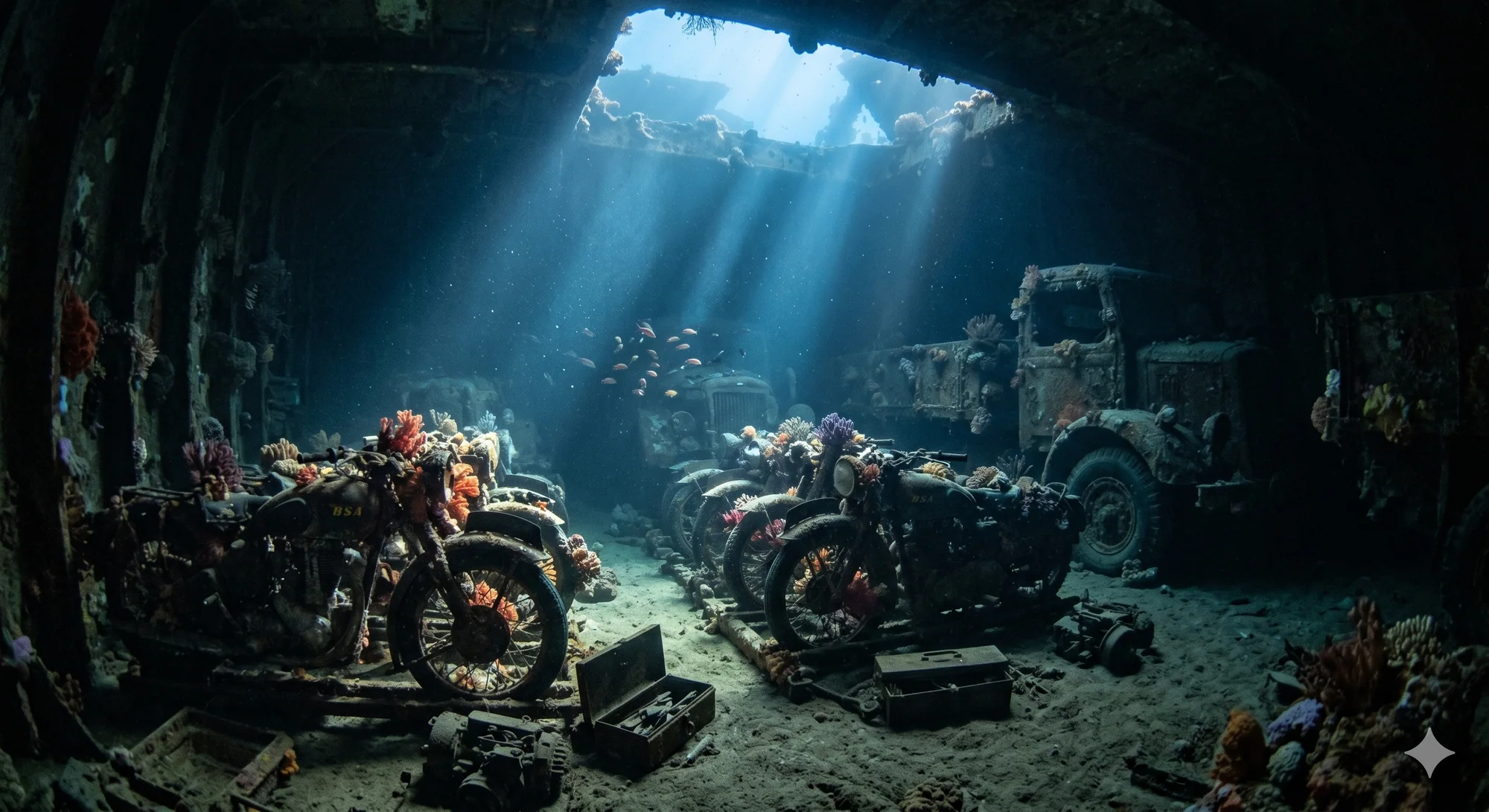
Arrive at the Thistlegorm before 6am on a liveaboard, before the day boats, before anyone else, and you will understand immediately what this wreck is. Hold 1 opens below you and the torchlight reaches down through clear, cold water to pick out the rows of BSA M20 motorcycles in their racks, exactly as they were loaded at Birkenhead in 1940. Handlebars. Frames. Tyre tread. Untouched for eighty years. The silence is complete.
Now come back at 10am and count the boats.
On a busy summer day, twenty or more day-trip vessels may be moored simultaneously over the Thistlegorm. The water above the wreck is churned white. Visibility in the holds drops as hundreds of divers stir the silt that has accumulated since 1941. Anchors have damaged the superstructure. Artifacts have disappeared. The coral that colonised the hull over decades, soft corals, hard corals, gorgonians, has been broken, scraped and knocked off. What was a cathedral is becoming a quarry.
The Thistlegorm is not a remote site. It is not beyond reach. It is not slowly degrading from the effects of climate change or ocean acidification, forces that are real and serious but act across decades. What is happening to the Thistlegorm is faster than that, more direct than that, and entirely preventable. We are choosing to do this.
What it is and how it got there
The SS Thistlegorm was a British armed merchant vessel launched in 1940, 126 metres of Glasgow-built steel loaded in the autumn of that year with supplies bound for the Eighth Army in North Africa. On the night of 6 October 1941, she was lying at anchor in the Strait of Gubal, waiting to transit the Suez Canal, when two bombs from a German Heinkel He 111 of Kampfgeschwader 26 struck Hold 4 at the stern and detonated the ammunition cargo. The Thistlegorm sank in minutes. Of the 130 men aboard, nine were killed.
She lay undisturbed for fifteen years. Jacques-Yves Cousteau found her on the Calypso expedition in 1956, dived her, filmed her and documented her cargo with the wonder that discovery produces. He did not publish the coordinates. The Thistlegorm returned to obscurity.
She was rediscovered in the early 1990s and slowly became known to the dive operators based in Sharm el-Sheikh. By the late 1990s she was in the dive magazines. By the early 2000s she was on every liveaboard itinerary and every day-trip menu out of Sharm. She had gone from one of the best-kept secrets in diving to one of the most visited wrecks on earth, and that transformation happened in about five years.
"Hold 1 at 6am, motorcycles in rows, exactly as loaded in 1940. Torchlight picking them out one by one. Nothing else moves. This is what the Thistlegorm still is, when you are first on it."
What the wreck holds
The cargo is the Thistlegorm's reason for being, and it is more extraordinary than any description does justice to. Hold 1 holds BSA M20 motorcycles, loaded in racks and still sitting in them. Hold 2 holds Bedford OY trucks, Bren gun carriers, and Lee-Enfield rifles. Hold 3 holds rubber Wellington boots, aircraft parts and spare motorbike frames, mundane materiel that becomes arresting when you find it sixty feet underwater, undisturbed for eight decades. Hold 4, the explosion point, is gone.
When the blast detonated the stern ammunition, the force threw two full-size steam locomotives off the deck. They are not near each other. One landed to the west of the wreck, the other to the east near the bow. Each is a locomotive, full scale, coral-covered, disorienting in the way that only things that have no business being underwater can be. The stern gun remains mounted. Eighty years after it was last handled, it still points at a sky it cannot see.
The documented degradation
Divers who first visited the Thistlegorm in the early 1990s and return today are looking at a changed site. This is not subjective nostalgia. The changes are visible, photographic and in some cases irreversible.
The three causes, and they are not mysterious
The Thistlegorm is degrading because of three things that are well understood, well documented and entirely within human control. None of them is controversial. The question is not what is happening. The question is whether the industry and its operators take collective responsibility before the window closes.
Overcrowding. The Thistlegorm sits within the Strait of Gubal in open water, approximately 22 nautical miles from Sharm el-Sheikh. It is reachable by day boat, and it is on the menu of almost every operator running out of Sharm. On peak season days, the number of vessels over the wreck at the same time has reached twenty or more. There is no legal limit. There is no concurrency cap. There is no booking system. Every boat that can get there can dive it, and they do. The cumulative physical impact of that volume of bodies in the water, in and around a fragile, unprotected historical wreck, is not a theory. It is a measurable, visible consequence that has been documented by divers with photographs taken decades apart.
Anchoring on the wreck. Mooring buoys have existed at the Thistlegorm, HEPCA, the Hurghada Environmental Protection and Conservation Association, has installed systems at the site. Their use is inconsistent. Boats anchor directly on or near the wreck when moorings are occupied or unavailable, and anchor chains dragging across the superstructure produce the kind of damage that is not recoverable. Metal bent or broken from an 1941 hull does not grow back. Coral stripped from a section of railing by an anchor chain takes decades to re-establish, if the anchor doesn't come back next season.
Artifact removal. The Thistlegorm is a war grave. Nine men died on her. Her cargo has protected status under Egyptian law as a historic wreck. Removing anything from the Thistlegorm is illegal. Items have nonetheless been reported missing over the years, small pieces, objects pocketed in the holds. The legal protection exists. The responsibility to respect it sits entirely with individual divers. A wreck that receives hundreds of thousands of visits per year and loses even a small fraction of its artifacts to souvenir-taking will, over decades, become empty.
"The motorcycles in Hold 1 are still intact. If the volume of visitors continues unchecked, they may not be in twenty years."
What can still be saved
The Thistlegorm is not lost. That matters and is worth saying clearly, because the response to conservation arguments is often fatalism, it's already gone, there's nothing to be done. That is not true. Hold 1 still has its motorcycles in their racks. Hold 2 still has its trucks. The locomotives are still on the seabed where the blast threw them in 1941. The stern gun still points at the surface. The wreck's historical integrity, the thing that makes it extraordinary, is still largely intact. What is being lost is the margin around that integrity: the coral, the structural details, the atmosphere that comes from a site that has not been churned into a cloud of silt by the time you arrive.
What is needed is not complicated. A strict concurrent vessel limit, ten boats maximum, would transform the experience and dramatically reduce physical damage. Mooring compliance, already required by site rules, needs to be treated as a genuine obligation by operators rather than a preference: anchoring directly on a wreck causes structural damage that nothing can undo. A booking and slot system would distribute pressure across the day and give the silt time to settle. None of these measures would significantly reduce revenue from the site. They would protect the thing that generates the revenue.
The comparison that stands is this: the Great Barrier Reef now has zoning, limits and enforcement after decades of damage. It will take centuries to recover what was lost in decades of unmanaged access. The Thistlegorm is smaller, more fragile and more concentrated. The window to act is shorter. Every season of inaction is a season of compounding loss.
What to do if you dive it
Book a liveaboard that anchors overnight and dives at first light. That window, one or two hours on the wreck before the day boats arrive, is still one of the finest dives available anywhere on earth. The silt has settled. The holds are clear. The motorcycles in Hold 1 are lit by your torch and nothing else moves. It is worth the extra cost and the early alarm.
Perfect buoyancy before you enter. A wreck specialty is not optional for the holds, it is the difference between a diver who moves through the Thistlegorm without touching anything and one who doesn't. Take nothing. Photograph everything. Touch nothing. The person who dives this wreck in 2045 deserves to find it the way you found it.
The Atlas documents the degradation of the Thistlegorm as a matter of public record and advocates for concurrent vessel limits, mooring compliance as a genuine operator obligation, and a booking system to distribute diver pressure across the day. The Thistlegorm is a war grave, a world-class dive site and an irreplaceable piece of maritime history. The diving industry, operators, guides and divers, is collectively responsible for what it becomes.
British armed merchant vessel. 126m. Launched 1940. Sunk 6 October 1941 in the Strait of Gubal.
Two bombs from a Heinkel He 111 of Kampfgeschwader 26 struck Hold 4 and detonated the ammunition cargo.
BSA M20 motorcycles, Bedford trucks, Bren carriers, Lee-Enfields, Wellington boots, two steam locomotives.
Deck at 16–28m. Hold floors at 24–30m. Locomotives on seabed adjacent to the wreck.
Found on the Calypso expedition in 1956. Coordinates not published. Commercially rediscovered in the early 1990s.
The full dive site profile, holds, locomotives, night dive, safety notes and operator recommendations.
Member Comments
Leave a comment
Keep reading, and open the whole Atlas.
A free account unlocks every dive site guide and map, the marine life library, member reports, and the full incident log. Free to join.
Join free to keep reading