Diving with Sharks, The Rules That Actually Matter
Oceanic whitetips at the Brothers. Hammerheads at Jackson Reef at dawn. Threshers off the deep wall before sunrise. A Red Sea-specific guide to in-water conduct, species by species, site by site.
Most divers encounter their first Red Sea shark and do everything wrong, fin hard toward it, point at it, try to close the distance. The shark leaves. The diver is disappointed. The guide says nothing because there is nothing to say: the moment is gone and it was the diver who ended it.
The Red Sea holds some of the most accessible shark diving on the planet. Oceanic whitetips cruising offshore seamounts. Scalloped hammerheads in schooling aggregations in current-driven water at depth. Threshers ascending the wall in the hour before the sun comes up. Grey reef sharks holding position in the channel. These animals are still here, in numbers that most of the world has already lost. What you do in the water determines whether that encounter lasts thirty seconds or thirty minutes, and whether the animal comes back at all.
This is not generic shark diving advice. It is specific to the species, conditions and dive culture of the Egyptian Red Sea, written from the perspective of someone who has spent a decade on these reefs.
The sharks you will meet
The species matters. Each one behaves differently, occupies different water, and responds to divers in its own way. Treating them as interchangeable, generic "sharks" that all need the same response, is the first mistake.
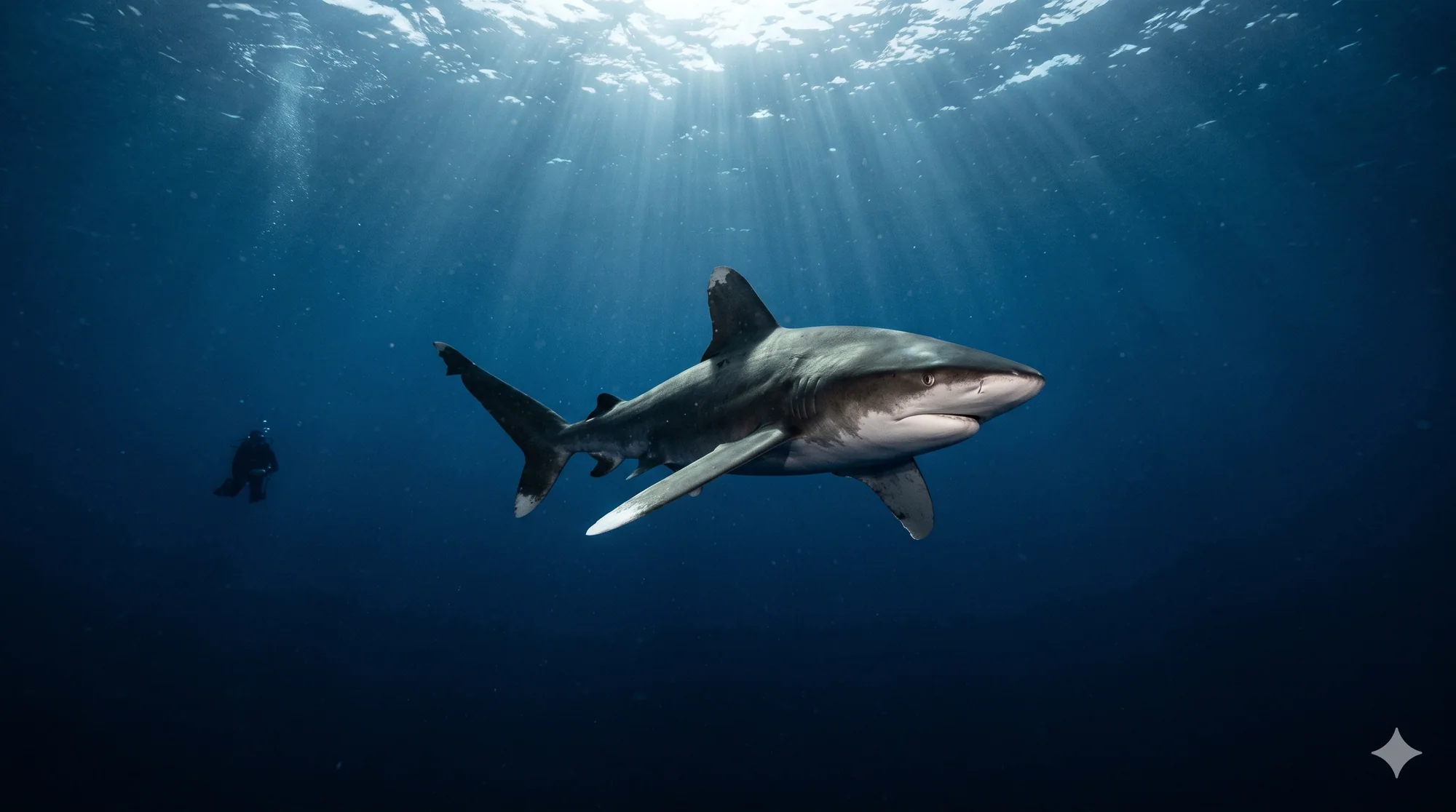
Oceanic whitetip (Carcharhinus longimanus), Critically Endangered globally, with one of its last strongholds in the Red Sea. Slow-moving, persistent, investigative. They follow the boat, they follow divers, and they do not leave because you look at them. They associate liveaboard boats with food scraps and have done for decades, this makes them bold around vessel moorings in a way they are not elsewhere. The OWT is the species most people are unprepared for because it does not behave like a reef shark. It will approach. It will circle. It will come back. Your job is to stay calm, stay horizontal, and hold your position.
Scalloped hammerhead (Sphyrna lewini), schooling pelagics that move through offshore reefs in current-driven conditions, forming aggregations at depth in the early morning. They are skittish. They are not investigating you. They are moving through on their own route and will turn and leave if the group is large, loud, or descending aggressively toward them. Go deep, go slow, go quiet. Hold depth. Let them come to you or pass by on their own terms.
Thresher shark (Alopias vulpinus), encountered at specific offshore seamounts on early morning first dives at 30 metres plus, typically ascending the wall from depth. They are not interested in divers. A thresher that appears will pass through the midwater and disappear. The encounter lasts as long as you give it space. Any aggressive finning toward it ends it immediately.
Grey reef shark (Carcharhinus amblyrhynchos), territorial. The grey reef is the species most likely to perform a threat display: back arched, pectoral fins dropped, exaggerated lateral swimming. If you see this, back away slowly. Do not turn. Do not approach. The grey reef shark is communicating clearly that you are too close. It is the only Red Sea species where a change in your behavior has a direct and immediate effect on the outcome.
Whitetip reef shark (Triaenodon obesus), nocturnal hunters, resting during the day on the reef or in overhangs. Almost universally uninterested in divers. If you see one moving during a day dive it will pass you without acknowledgment. Treat them with the same respect as any other species and they require no special consideration.
Before you enter the water
The encounter begins before you roll off the boat. Guides who dive these sites regularly will brief you on what is in the water that day and how they want the group to behave. Listen to that briefing properly. Not as background noise while you check your camera settings. The signals your guide uses underwater are usually established in the briefing, if you miss them, you are diving without a communication channel.
Check your buoyancy before you go anywhere near a shark site. An uncontrolled diver thrashing to hold depth is the single most disruptive presence in the water. Sharks read movement. A diver who is finning constantly to stay at depth looks and sounds nothing like a neutrally buoyant one. If your buoyancy is not good enough to hold position in a current without effort, this will cost you every encounter.
At offshore liveaboard sites where OWTs are known to patrol, do not enter the water with food on your person, and do not enter immediately after anyone has been handling bait or fish at the back of the boat. If the boat has been fishing, wait. These animals have learned to associate certain cues with food. There is no reason to add yourself to that association.
In the water
The rules below are not elaborate. They are consistent across species and conditions. The common thread is that you are removing stimuli that trigger investigation or avoidance, and replacing them with stillness that allows the animal to treat you as part of the environment.
Do
Don't
When a shark approaches close
A close approach is not an attack. It is an inspection. Sharks investigate unfamiliar objects, particularly objects that produce sound, bubbles, or light. An OWT that swims directly toward you is doing what OWTs do: gathering information. Your response to that approach determines what happens next.
Hold your position. Do not back away, do not lunge forward, do not make any sound or movement that you would not make if the shark were ten metres further away. If the animal comes within arm's reach, and with an OWT this is not unusual, you may use the back of your hand or a flat palm to gently deflect the animal away from your body. Not a push. Not a slap. A deflection, calm and deliberate. Then return immediately to neutral position.
What you must not do is flinch backward in a way that signals fear or injury, both of which increase interest. The animal is reading you. The calmer you are, the less information it gets, and the sooner it will move on to something more interesting.
The grey reef shark threat display is a different situation, that is not curiosity, it is a warning. The animal is telling you that you have entered its space and it wants you to leave. Respect that. Back away. Do not turn your back. Give it room and the situation resolves. Every recorded grey reef bite has been preceded by a threat display that was ignored.
What these encounters actually are
The Egyptian Red Sea has lost an estimated 80 percent of its shark population since the 1970s. What remains is concentrated at a handful of offshore sites where enforcement has held and the ecosystem still functions. The encounters available here, a school of scalloped hammerheads in a current at dawn, an oceanic whitetip making a slow pass ten metres out, are not guaranteed anywhere else on earth at this level of accessibility.
The etiquette described in this article protects the diver in the short term and the animal in the long term. Sharks that associate divers with stress move off the sites. Sites that lose their sharks lose everything that made them worth going to. The rules are not an inconvenience. They are the reason the encounter is possible.
A single reef shark generates approximately $200,000 annually in dive tourism revenue over its lifetime. It generates that figure once in the net. The choice is not difficult to analyse. The Red Sea Atlas supports shark protection across all Egyptian waters and believes that dive operators have a direct economic interest, not just an ethical one, in enforcing consistent in-water conduct standards. If your guide is not briefing your group on how to behave around sharks before you enter the water, choose a different guide.
Critically Endangered. Bold and persistent around liveaboard moorings. The species most divers are least prepared for.
Schooling, skittish, current-driven. Forms aggregations at depth in the early morning at offshore reef sites.
Early morning, deep wall. Pelagic and uninterested in divers. Passes through, give it room.
Territorial. The only Red Sea species that performs a documented threat display before escalating.
Nocturnal hunters, resting during the day. Low interaction risk. Respond the same as any other species.
Leave a comment
Keep reading, and open the whole Atlas.
A free account unlocks every dive site guide and map, the marine life library, member reports, and the full incident log. Free to join.
Join free to keep reading