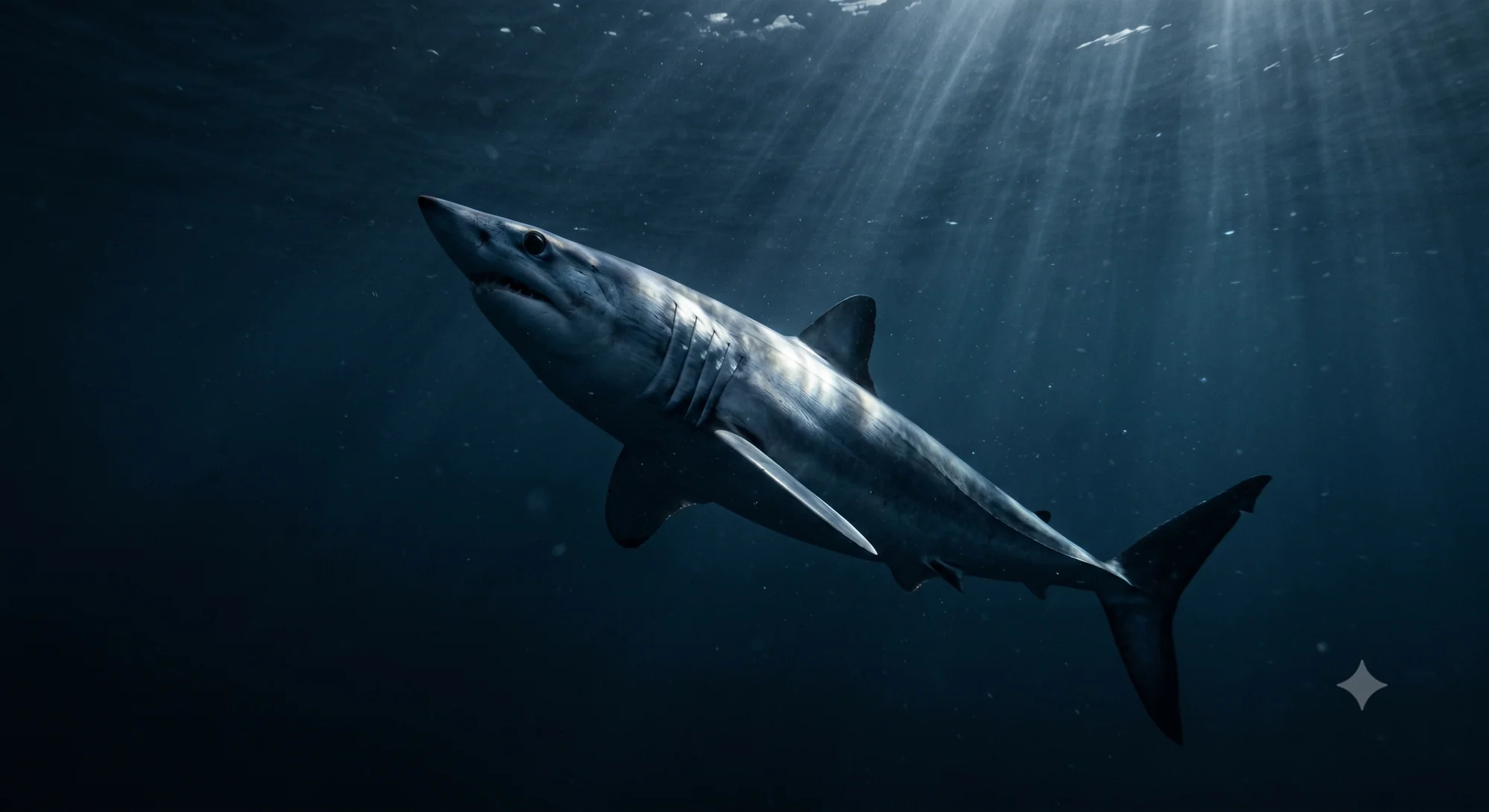
An Endangered Mako Appeared Off Quseir, Then Fishermen Caught and Killed It
A three-metre shortfin mako shark appeared in shallow coastal water near Quseir on 15 May 2026. No attack occurred. Local fishermen caught and killed it. Egypt's National Institute of Oceanography formally condemned the killing as scientifically unacceptable, then deleted the statement without explanation.
The shortfin mako has been classified Endangered on the IUCN Red List since 2019, with a population reduction estimated at 46–79% over 75 years. It is also listed on CITES Appendix II.
The shark was not aggressive and had not approached swimmers. The catch was triggered by public fear after videos circulated showing the animal in shallow coastal water near a beach.
The Red Sea Reserves Authority and National Institute of Oceanography and Fisheries (NIOF) conducted an autopsy. Stomach completely empty. Liver abnormally low weight. The shark was in a severely compromised condition before it was caught.
The NIOF director issued a formal statement calling the killing scientifically and environmentally unacceptable. Within hours, it was deleted from official government platforms without explanation.
What happened
On the morning of 15 May 2026, a shortfin mako shark appeared in shallow coastal water off the beaches of Quseir, a small city on Egypt's southern Red Sea coast. The shark, estimated at around three metres in length, was filmed by onlookers and the footage spread quickly across Egyptian social media. By that evening it had reached national news.
No attack took place. No swimmer was approached. The animal was in open coastal water near a beach that mixes tourists and residents, a location that, understandably, alarmed people when a three-metre shark was visible from the shore. Local fishermen moved to pursue and catch it. The nature protection authority was present and observed the operation without intervening to redirect it.
The shark was captured alive on 16 May and a decision was made to transfer it to the Marine Sciences Institute in Hurghada. It did not survive. It was subsequently dissected by the Red Sea Reserves Authority and the National Institute of Oceanography and Fisheries.
Timeline
What the autopsy found
The post-mortem, conducted jointly by the Red Sea Reserves Authority and the NIOF in Hurghada, found a stomach with no food remains and a liver described as abnormally light for an animal of that size. Both are consistent with a shark that had not been feeding successfully and was in a state of physiological stress.
Dr. Amjad Shaban, a shark researcher at the National Institute of Marine Sciences, told Egyptian outlet Masrawy that the animal was likely a female in the advanced stages of labour. Shortfin makos give birth to live young and spring is a typical pupping season for the species, with litters of around fifteen pups. Dr. Shaban noted that the institute was not consulted or notified before the capture took place.
A separate fisheries specialist at the Red Sea Institute of Oceanography described the inshore appearance as scientifically significant, attributing it to a combination of food scarcity, rising water temperatures and shifting fish migration patterns through the Bab al-Mandab strait. Mako sharks are pelagic hunters, normally found in deep offshore water. Appearances this close to a populated beach are rare.
One source identified the shark as male; Dr. Shaban's account, from a named specialist who examined the animal, identifies it as female and in labour. The Atlas reports the expert view as more reliable, while noting the discrepancy exists in the record.
The official response, and its deletion
On 17 May, the director of the National Institute of Oceanography and Fisheries issued a public statement. It was direct: the capture and killing of the shark was scientifically and environmentally unacceptable. Large marine animals appearing in coastal waters require clear scientific protocols, she wrote, with the participation of specialised research bodies, not random hunting. The correct response would have been to guide the animal back to open water.
Within hours, that statement was removed from all official government platforms. Al-Masry Al-Youm reported the deletion and noted there was no official explanation for it. An environmental expert quoted in the same report called for decision-making frameworks based on science rather than social media pressure. The deleted statement was not replaced with any clarification.
The pattern is familiar: an accurate and appropriate assessment of a marine incident, followed by its quiet removal. What changed between the publication of the statement and its deletion is not known. The Atlas notes the sequence of events and records it here, since it is part of the story.
Conservation context
The shortfin mako is the fastest shark in the ocean and one of the most commercially pressured. It has been classified Endangered on the IUCN Red List since 2019, with population estimates suggesting a reduction of 46 to 79 percent over 75 years driven primarily by commercial fishing bycatch and targeted harvest for its fins and meat. It is listed on CITES Appendix II, meaning international trade requires permits.
Egypt does not appear to have domestic legal protection specifically covering mako sharks. The NIOF condemnation was framed in scientific and ethical terms rather than legal ones. No reports have indicated that the fishermen faced any legal consequences. For context, Egyptian authorities arrested fishermen who hunted a whale shark off Marsa Alam in 2023, suggesting that the legal response to the killing of protected marine species is inconsistent.
The NIOF statement, before it was deleted, made one point worth preserving: mako sharks serve a function in the Red Sea ecosystem by preying on weak and diseased fish. An animal that rarely approaches populated coastline did so while debilitated and possibly in labour. The encounter was resolved by killing it.
Why sharks matter
Sharks are apex predators, and apex predators regulate ecosystems from the top down. By removing sick, weak and slow-moving fish from prey populations, they raise the average fitness of everything below them in the food chain. Healthy prey populations produce healthier reef systems. The relationship is not incidental, it is structural.
The effect extends beyond direct predation. The presence of sharks changes how prey species behave: where they feed, how long they stay in one place, how aggressively they graze. On coral reefs, this behavioural pressure prevents herbivorous fish from overgrazing algae in ways that would otherwise smother the coral. The sharks do not need to kill anything for this to work. Their existence in the water is enough.
In the Red Sea specifically, shark populations have been in decline for decades. What was once one of the most shark-dense bodies of water on earth has thinned substantially through fishing pressure and finning. The ecosystem consequences of that thinning, more diseased fish, less regulated prey, degraded reef structure, are already measurable in some areas. The mako that appeared off Quseir was not a danger to the coast. It was part of a system that needs sharks in it.
Related reading
A full archive piece on shark ecology: trophic cascades, the landscape of fear, nutrient cycling, the 71% global population decline, and the sanctuaries where recovery has been documented.
A debilitated, endangered animal came inshore and was killed because it caused fear. The scientists who understood what they were looking at were not consulted in time. The official body that said so publicly then withdrew its statement without explaining why. The Atlas records all of this as part of the Red Sea's marine record. The correct response, as the NIOF stated before going silent, was to return the animal to deep water.
Reporting draws on CNN Arabic (17 May), Youm7 (15 May), Masrawy (18 May), Al-Masry Al-Youm autopsy and statement-deletion reports, Al Khaleej and Dostor. Expert commentary attributed to Dr. Amjad Shaban (National Institute of Marine Sciences) and Dr. Ashraf Sadek (Red Sea Institute of Oceanography). Statements translated from Arabic.
Leave a comment
Keep reading, and open the whole Atlas.
A free account unlocks every dive site guide and map, the marine life library, member reports, and the full incident log. Free to join.
Join free to keep reading