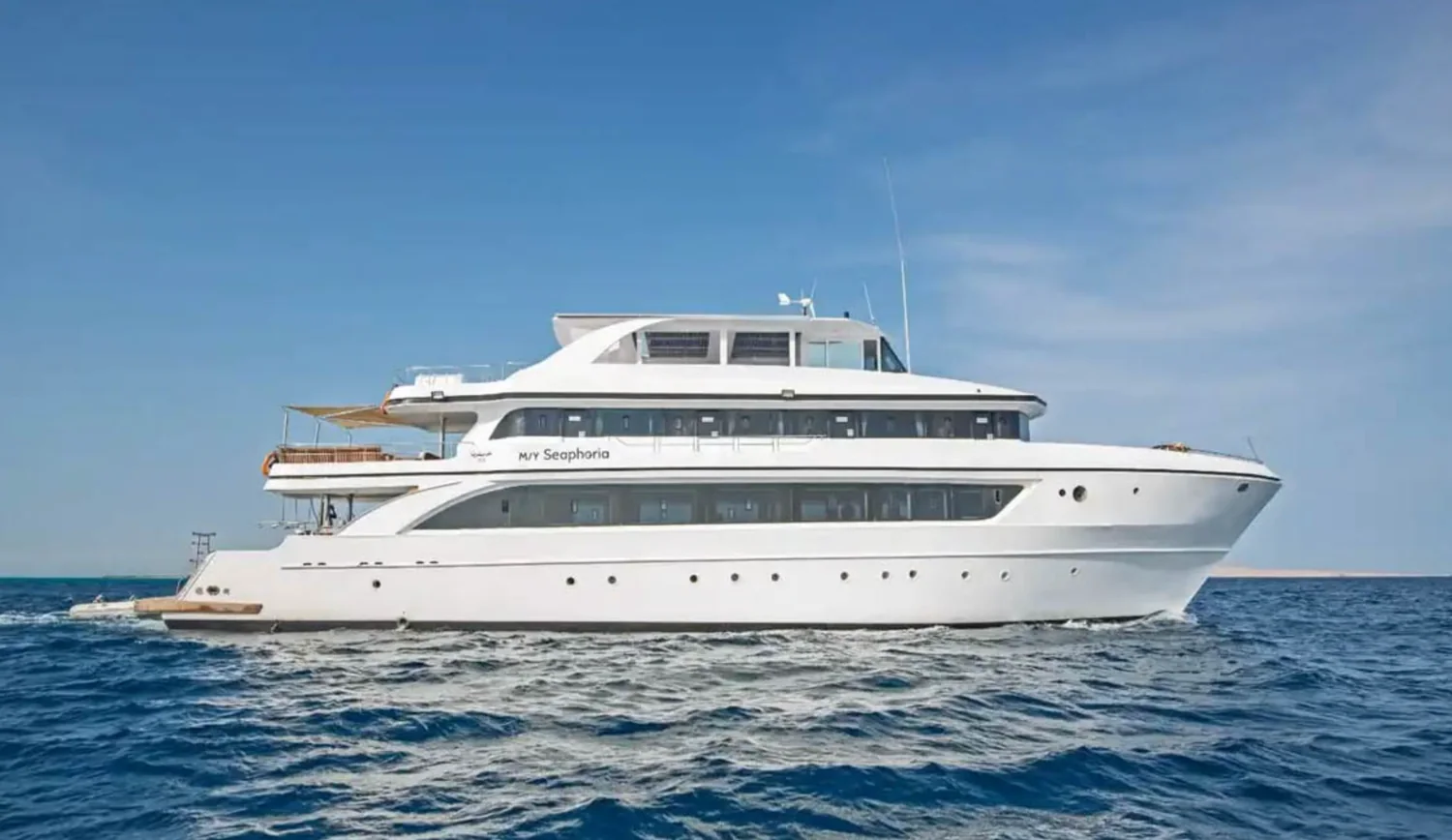
MY Seaphoria, Grounded at Daedalus, Broke in Two
MY Seaphoria grounded at Daedalus Reef on 25 November 2025 and broke in two. All 30 rescued. The captain was found to have been sleeping.
In the early hours of 25 November 2025, the 35-metre liveaboard MY Seaphoria struck the reef at Daedalus, one of the most remote and most heavily dived offshore reefs in the Egyptian Red Sea. The vessel grounded, broke into two parts that drifted apart from each other, and eventually sank. All 30 people on board, 21 tourists and 9 crew, were rescued. Debris from the wreck floated around Daedalus for days before both sections went under.
What happened on the bridge
In the account that reached us, the vessel's captain was asleep at the time of the grounding. The first mate was in control of the bridge as Seaphoria approached Daedalus. According to what was reported, the first mate could not see the reef on the approach, and the vessel struck it. The captain was woken by the collision.
Daedalus Reef sits 60 kilometres offshore, reached only by sea. It has no surrounding landmass , the reef table sits just at or slightly above the surface at the end of a long open-water crossing. Arriving in darkness or poor visibility, without adequate navigation precautions, means the reef announces itself by contact. That is what happened here.
The vessel breaks apart
The grounding was severe enough that the 35-metre hull did not hold together. Seaphoria broke into two sections. The two parts drifted apart from each other on the surface, an unusual outcome that speaks to the force of the initial impact and the structural compromise that followed. The vessel did not sink quickly. Debris, hull material, equipment, and other wreckage, was visible in the water around Daedalus Reef for several days after the incident. Eventually both sections of the vessel went under.
The 30 people on board were transferred to the Turquoise, another liveaboard operating in the area. The presence of another vessel nearby made the evacuation possible. Daedalus is remote enough that had no other boat been within range, the outcome could have been materially different. All 30 were evacuated without fatalities.
Daedalus and what the reef requires
Daedalus Reef is not a forgiving destination. Sixty kilometres from the nearest coast, with no natural harbour and no shelter from the elements, it demands navigation that treats the approach with full attention. The current Egyptian requirement that liveaboards carry two licensed captains exists precisely for situations like this, a night approach to an offshore reef where a single point of failure on the bridge can produce consequences that cannot be undone.
The Egyptian Lighthouse Authority maintains a light structure on Daedalus. Night approaches to lit offshore reefs are navigable, they are made safely by dozens of liveaboards every season. What is required is that the person responsible for the approach is watching for the reef, not relying on the absence of an alarm.
"Daedalus Reef has a lighthouse. The problem was not that the reef was invisible. The problem was that the person watching for it was not fully in position to do so."
The same owner, Seaduction
MY Seaphoria was operated under the same ownership as MY Seaduction, which sank in October 2024 after a storm in the deep south. Seaphoria had been acquired from Dive Pro Liveaboard prior to the grounding and was operating under different ownership at the time of the incident. The Atlas documents this connection as part of the public record. Two vessels, same owner, both lost within thirteen months.
We draw no legal conclusions from this. The facts are available and divers deserve access to them. Both incidents are documented in full in this log.
MY Seaphoria is part of the permanent incident record maintained by the Atlas. All 30 people on board were rescued, a positive outcome that the crew and the nearby Turquoise liveaboard made possible. The Atlas will continue to document the reef damage assessment when it becomes available. Before booking any liveaboard operating to offshore sites such as Daedalus, ask your operator about their bridge watch protocol and overnight approach procedures. A reputable operator will answer directly.
Grounded at Daedalus on approach. Exactly one year after Sea Story. All 30 rescued.
Captain asleep on approach. First mate in control, could not see the reef. Vessel struck and grounded.
Hull failed after grounding. Vessel split into two sections that drifted apart. Debris at Daedalus for days.
21 tourists and 9 crew transferred to nearby liveaboard Turquoise. No fatalities.
Seaphoria and MY Seaduction (sank Oct 2024, deep south) shared the same ownership. Seaphoria was acquired from Dive Pro.
Leave a comment
Keep reading, and open the whole Atlas.
A free account unlocks every dive site guide and map, the marine life library, member reports, and the full incident log. Free to join.
Join free to keep reading