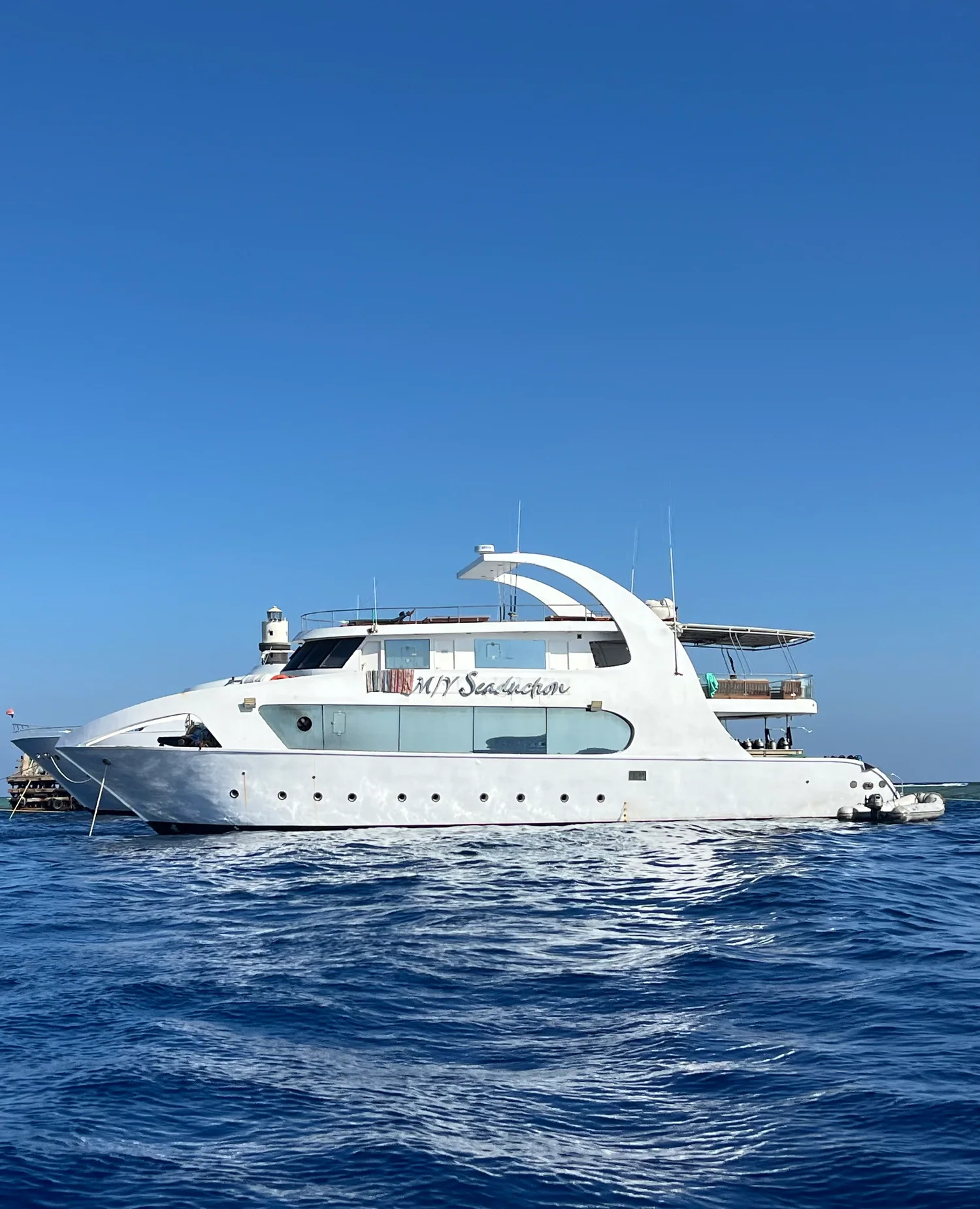
MY Seaduction, Storm, All 28 Rescued
MY Seaduction was struck by a storm in October 2024. All 28 passengers and crew were rescued. Same owner as MY Seaphoria.
In October 2024, the liveaboard MY Seaduction sank in heavy weather in the deep south of the Red Sea. All 28 people on board, 18 divers and 10 crew, were rescued. Nobody died. That all 28 people got off a sinking vessel alive, in open water, far south of the normal rescue range, is the part of this story worth holding onto. The rest is a record of what the conditions on that route can do to a vessel that isn't sized for them.
The route
The deep south route is one of the most remote itineraries available on the Red Sea. Vessels depart from Hamata, itself already well south of Marsa Alam, and sail progressively south toward the Sudan border, with dive stops at sites along the Egyptian coast and offshore reefs that are rarely visited by the standard liveaboard fleet. Rocky Island, Zabargad, St. John's Reef complex, Fury Shoals and the deep south reefs beyond Hamata are the territory. The further south you go, the further you are from port, from rescue infrastructure, and from any meaningful shelter if the weather turns.
The Red Sea narrows as it approaches the southern end. The prevailing wind and swell patterns in this section of the sea can produce conditions that differ substantially from what the northern fleet typically encounters. Operators and divers experienced in the deep south understand this. Vessels that operate this route need to be sized and built for open-water conditions, specifically, for the possibility of heavy weather in an area where the options are limited.
What happened
MY Seaduction was a smaller liveaboard, not a large offshore vessel, operating the deep south route in October 2024. The vessel encountered heavy storm conditions. A large wave struck the hull with sufficient force to breach it. The hull failed. The vessel began taking on water and sinking.
The evacuation was successful. All 18 divers and all 10 crew were rescued. In the deep south, in storm conditions, with limited proximity to rescue vessels, getting 28 people off a sinking boat alive is not a given. The crew's emergency response saved everyone on board.
Vessel size and route selection
The deep south route is not inherently more dangerous than other Red Sea liveaboard itineraries, but it rewards a different category of vessel. The Red Sea Aggressor V, which operates the same general territory, is a purpose-built offshore liveaboard specifically chosen for its seakeeping in open-water conditions. Smaller vessels designed primarily for the sheltered northern routes carry a different risk profile when they go deep south.
This is not an obscure technical point. Divers booking the deep south route have a right to know what vessel they are boarding and whether it was built for the conditions they will encounter. Before booking any deep south itinerary, ask the operator directly about the vessel's size, hull construction and offshore certification. A reputable operator will have no hesitation answering.
"The deep south route is outstanding diving. It is also open water, far from port, and the conditions demand a vessel that was built for it."
The same owner
MY Seaduction and MY Seaphoria, which grounded and sank at Daedalus Reef in November 2025, were operated under the same ownership. Seaphoria was acquired from Dive Pro Liveaboard before its grounding. The Atlas documents this connection as part of the public incident record. We draw no legal conclusions. The facts are what they are, and divers deserve access to them.
MY Seaduction is part of the permanent incident record maintained by the Atlas. The survival of all 28 people on board reflects the effectiveness of the crew's emergency response. The incident also illustrates the importance of vessel selection on deep south itineraries, ask your operator about hull construction and offshore capability before booking any route that takes you south of Hamata.
Storm conditions on the Hamata deep south route. Hull failure. Vessel sank.
Large wave struck and breached the hull of the smaller liveaboard. Vessel not sized for the conditions encountered.
18 divers and 10 crew evacuated successfully. No fatalities. Effective emergency response by crew.
MY Seaduction and MY Seaphoria (grounded Daedalus, Nov 2025) operated under the same ownership.
Hamata departure heading south toward the Sudan border. One of the most remote liveaboard routes in Egypt.
Leave a comment
Keep reading, and open the whole Atlas.
A free account unlocks every dive site guide and map, the marine life library, member reports, and the full incident log. Free to join.
Join free to keep reading