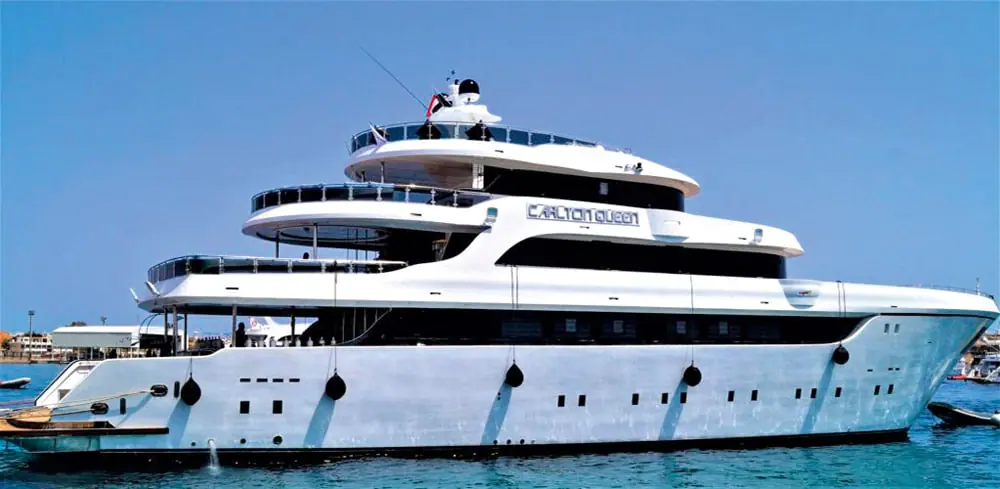
MV Carlton Queen, Stability Failure in the Strait of Gubal
MV Carlton Queen experienced a stability failure in the Strait of Gubal on 24 April 2023. All 35 aboard were rescued. A documented account of how and why it happened.
The MV Carlton Queen capsized in the Strait of Gubal on 24 April 2023. All 35 people on board , approximately 26 guests and between 9 and 12 crew, were rescued. Nobody died. That outcome was the result of luck, a nearby vessel, and the physical endurance of passengers who found themselves escaping through broken glass doors and cramming into a life raft built for far fewer people. The Carlton Queen was on only its second voyage.
The list that was there from the start
Survivors reported that the vessel had a noticeable list, a sideways tilt, from the very beginning of the voyage. It was a few degrees at first. The crew attributed it to the water tanks settling and to passengers using the bathrooms. By the second day the list had reached five to seven degrees. By Monday morning, before the capsize, it had reached between 20 and 30 degrees. Guests were sliding. Personal items were rolling across the cabin floors.
Survivors found the crew's explanation, water tanks, bathroom usage, difficult to accept given what they could see and feel. The vessel had not been in rough weather. The sea state that morning was described as calm. What was producing the list was not external conditions. It was the vessel itself.
What happened
While transiting the Strait of Gubal, the Carlton Queen made a turn. Combined with swell, the vessel heeled hard to starboard and did not recover. Its centre of gravity had moved too far outward. The vessel capsized, coming to rest on its starboard side. People were thrown. Cabins below the waterline flooded. The vessel did not self-right.
The vessel and its condition
The Carlton Queen was marketed as a 2022 vessel. Investigation revealed it was substantially older, approximately 20 years, and had been significantly modified and extended. Those modifications altered its stability characteristics in ways that the vessel's structure could not adequately compensate for. It had been on only one prior voyage, a kitesurf trip the week before, before the fateful dive charter.
Post-incident examination found compounding deficiencies. The life raft flares were non-functional, survivors described them producing only a faint fizz. One of the two life rafts malfunctioned and deployed inverted. Emergency escape routes had lockable doors, no emergency lighting, and were unmarked. Safety briefings had either not been conducted or were inadequate. The crew appeared poorly trained and unfamiliar with the vessel's emergency procedures.
The Carlton Queen had passed its CDWS inspection in early April 2023, just weeks before the capsize. The vessel met its required certification standards at the time of inspection. That gap between passed certification and actual vessel condition is a thread that runs through multiple incidents in the Red Sea record and is one of the core concerns the MAIB raised in its February 2025 safety bulletin.
"The list was there from the first hour. It was visible, it was felt, it was reported to the crew. Three days later the boat was on its side in the Strait of Gubal."
The rescue and what it took
The nearby liveaboard VIP Shrouq arrived and coordinated the rescue together with the Egyptian Navy. What survivors had to do to reach safety is a measure of how serious the situation was. People escaped through glass doors that had broken under the pressure of the capsize, using sofas that had floated out of the vessel as platforms. At least one passenger free-dived out of a submerged below-deck cabin to reach the surface. A life raft designed for 20 people held 37. The flares did not work. Among those on board was a couple on their honeymoon.
All 35 people were rescued. Three were treated for minor injuries. Nobody died. That outcome was not guaranteed. It was the result of a vessel being nearby, of passengers keeping their composure in extreme circumstances, and of a degree of fortune that should not be the margin between a close call and a mass casualty event.
The Carlton Queen is part of the permanent incident record maintained by the Atlas and was among the incidents that led directly to the MAIB's formal engagement with Red Sea liveaboard safety. All 35 people were rescued. What the incident demonstrates, a visible stability problem present from the first hour, crew dismissal of passenger concerns, and compounding safety equipment failures, is documented here as a resource for every diver planning a Red Sea liveaboard. If you were on board, use the comments below.
Second voyage of the vessel. List present from day one. Capsized during a turn. All 35 rescued.
Vessel progressively listed over three days, 5–7° by day two, 20–30° by the morning of capsize. Centre of gravity moved beyond recovery point.
Life raft flares non-functional. One life raft deployed inverted. No emergency lighting on escape routes. Escape doors unmarked.
Nearby liveaboard VIP Shrouq and Egyptian Navy responded. Three treated for minor injuries. No fatalities.
Carlton Queen passed CDWS inspection weeks before the capsize. The vessel met its required standards at the point of certification.
Leave a comment
Keep reading, and open the whole Atlas.
A free account unlocks every dive site guide and map, the marine life library, member reports, and the full incident log. Free to join.
Join free to keep reading