The World's Deadliest Dive Site, What the Arch at the Blue Hole Actually Is
The Blue Hole is a world-class dive site. The Arch at 52m is the reason it has claimed more lives than almost any other dive site on earth. Four specific mechanisms explain why, and why experience alone is not sufficient preparation.
The Blue Hole is a world-class dive site. The Arch has claimed more lives than any other dive site on earth. These two facts coexist. Understanding the second one is not optional.
The Blue Hole is a vertical underwater sinkhole 8km north of Dahab. It drops beyond 100 metres. The rim sits at 6 metres. The wall dive outside the hole is a genuinely exceptional dive. None of what follows is about that dive.
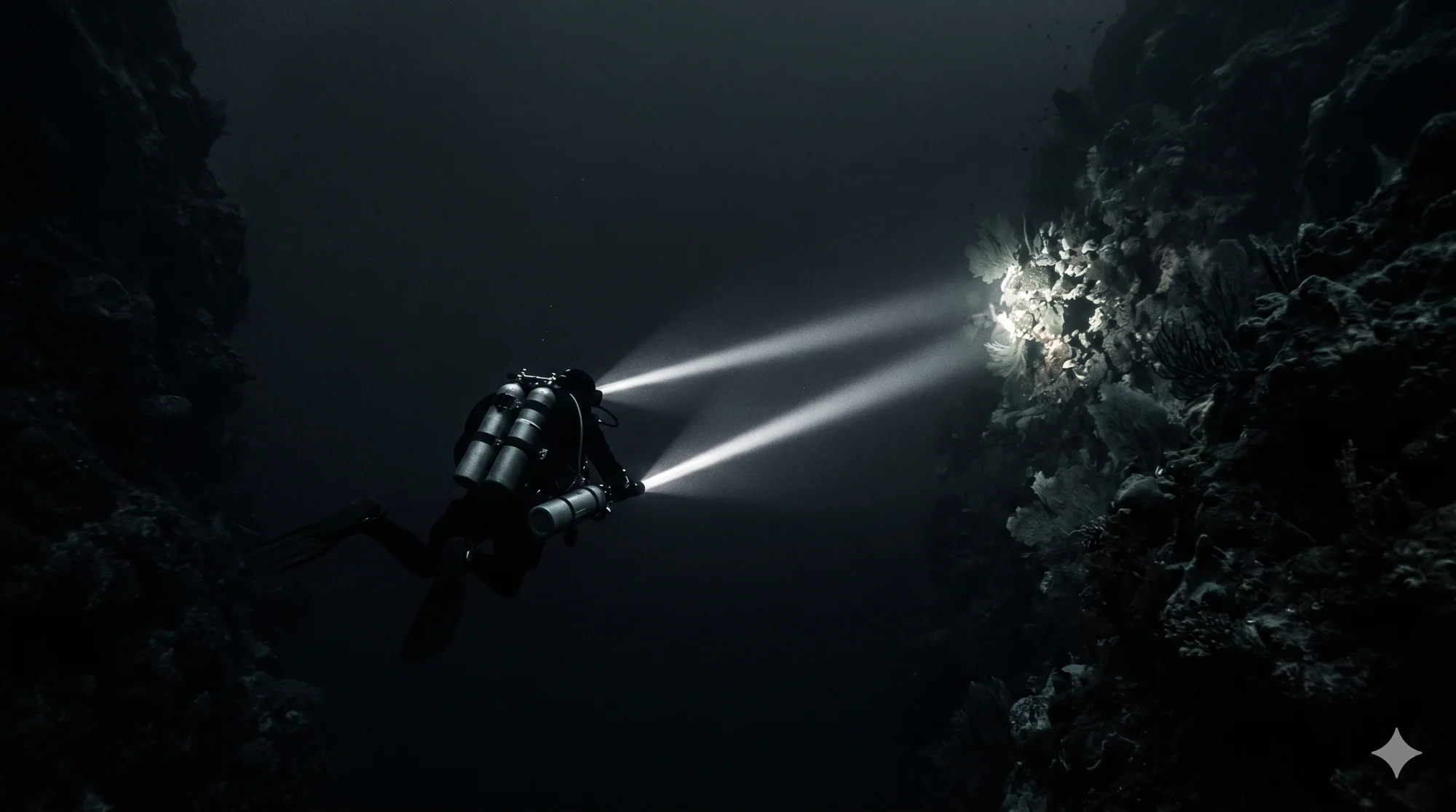
The Arch is a tunnel connecting the inside of the Blue Hole to the open water on the outside wall. It sits at 50–55 metres, varying with the tide. The tunnel is approximately 30 metres long with no bottom: open water below you the entire way through. It has killed more divers than any other single feature at any dive site on earth.
This article is about why. Not to frighten people away from the Blue Hole: the wall dive there is among the best in Egypt. But because the Arch continues to claim lives, and the reasons it does so are specific and explainable. Most of the people who died there were experienced divers who believed they were ready.
The Four Compounding Hazards
At these depths, narcosis is severe. The problem is that it does not feel severe. This is not a metaphor or a generalisation. It is the defining feature of deep narcosis. Your judgment is impaired before you notice the impairment. Inside the Arch, with no visual reference, in darkness, you need precise decision-making and spatial awareness. Narcosis removes both without announcing that it has done so. Divers have swum the wrong way inside the Arch and not made it out. They did not realise they were going the wrong way.
At 50 metres, your buoyancy collapses. The neoprene in your suit compresses to almost nothing under pressure. The air inside your BCD has also shrunk significantly. The volume that held you neutral at 20 metres is now a fraction of what it was. You need substantially more air in your BCD to stay neutral at this depth, and this requirement changes as you move. Active buoyancy control at depth is exhausting and easy to get wrong. Without a bottom to reference, drifting 10–15 metres deeper can happen without you noticing. You are then at 60–70 metres. The narcosis is worse. The buoyancy is worse. Past 66 metres on air, oxygen toxicity also becomes a factor: the partial pressure of oxygen climbs beyond the safe limit, and a convulsion underwater is almost always fatal. You have also accumulated a decompression obligation. A rapid or panicked ascent from that depth does not mean decompression sickness is a risk. It means it is a near-certainty.
Inside the Arch, you lose visual reference for the surface. Orientation in three-dimensional space, in the dark, narced, while managing buoyancy and gas: this is a different cognitive task from any recreational dive. Technical divers train specifically for this environment. Recreational divers, regardless of experience level, do not have that training and cannot substitute dive count for it.
This is the one most people do not know. The Arch is not visible from above 30 metres. You cannot see it from a safe depth and decide whether to proceed. To locate it, you have to descend to it. A diver who arrives at the Blue Hole intending to 'just have a look' must descend past 30 metres into open water to find the entrance. Already narced, already with bottom time compromised, already committed to a depth from which the situation can deteriorate fast. Searching for the Arch while narced, in the dark, with no bottom reference, is a separate way to die before you have even entered it.
Managing buoyancy, direction, gas consumption, narcosis and a decompression obligation simultaneously, in the dark, while swimming 30 metres horizontally with no bottom beneath you: this is what has killed divers here. Not reckless beginners. Experienced divers. Instructors. People who believed they were ready.
What It Actually Takes
Diving the Arch safely requires trimix breathing gas, stage bottles, full technical certification (TDI or equivalent), and a guide who dives it regularly, not occasionally. These are not bureaucratic requirements invented by cautious institutions. They are the minimum viable equipment and training set for the specific hazards this passage presents.
If any operator or guide in Dahab presents the Arch as an option on a recreational dive, or suggests that dive experience alone is sufficient preparation, leave. This is not a matter of personal risk tolerance. It is a matter of whether the person giving advice understands what they are talking about.
The Blue Hole is a site we recommend without hesitation. The Arch is a site we recommend without exception against recreational diving. These positions will not change based on diver experience, confidence, or persuasion. The Blue Hole site guide contains the full conditions, marine life, and the Arch warning, stated plainly, for the same reason this article exists.
Leave a comment
Keep reading, and open the whole Atlas.
A free account unlocks every dive site guide and map, the marine life library, member reports, and the full incident log. Free to join.
Join free to keep reading