Nabq
The largest protected coast in South Sinai, where the desert runs down to some of the most northerly mangroves in the world, a cargo wreck lies in the shallows and dugongs graze the seagrass a short drive from Sharm.
Where the desert meets the mangroves
Nabq sits on the Gulf of Aqaba coast a short drive north of Sharm el-Sheikh, the largest coastal protected area in South Sinai. Declared a protectorate in 1992, it covers roughly 600 square kilometres of desert plain, mountain, mangrove and reef, a full cross-section of Sinai landscapes packed into one stretch of coast. It begins almost at the edge of the airport and yet feels a world away from the resorts a few kilometres south.
The defining feature is the mangrove. Nabq holds some of the most northerly stands of mangrove forest in the world, dense grey-green thickets of Avicennia marina rooted in the tidal flats where fresh groundwater from the mountains meets the sea. These are among the most productive ecosystems on the coast: a nursery for young fish, a filter for the shallows, and a magnet for birds. The mangrove belt around Al Munqatea is the heart of the reserve.
History sits in the shallows here too. A cargo ship that ran aground on the reef decades ago still lies broken in the water off Rowayseya, its rusting hull visible from the shore against a backdrop of mangrove and mountain. It is one of the few Red Sea wrecks that can be seen without getting wet, and one of the more atmospheric sights on the Sinai coast.
Nabq is Bedouin country. The Muzeina have lived and fished along this coast for generations, and the small village of El Gharqana sits within the reserve itself. What Nabq offers is the opposite of the resort strip that shares part of its name: quiet, wild, and largely undeveloped, a protected coastline where the reef, the desert and the mangrove are still doing what they have always done.
Camps, resorts and open reserve
The Muzeina fishing village of El Gharqana sits inside the reserve, and simple Bedouin camps line its beach. Reed huts, fresh fish and Marmaria tea, with the mangroves and the wreck within walking distance. The authentic way to stay inside Nabq, though facilities are minimal by design.
A scattering of locally run camps along the Munqatea mangrove beaches, the quietest corner of the reserve. Used mostly for day trips, kayaking and overnight camping under exceptionally dark skies. Bring what you need; this is not a serviced resort.
Immediately south of the protected area, the Nabq Bay district of Sharm el-Sheikh holds a line of large all-inclusive resorts with private beaches and full facilities. The comfortable base for visitors who want to day-trip into the reserve without giving up a pool and air conditioning.
The full range of Sharm el-Sheikh accommodation, from budget to five-star, is 35 minutes away by road. Most visitors to Nabq base themselves in Sharm or Nabq Bay and reach the reserve on a half-day trip. The practical choice for anyone wanting a wider selection of hotels, dive centres and restaurants.
Mangroves, wreck and Bedouin country
Reef, desert and open sky
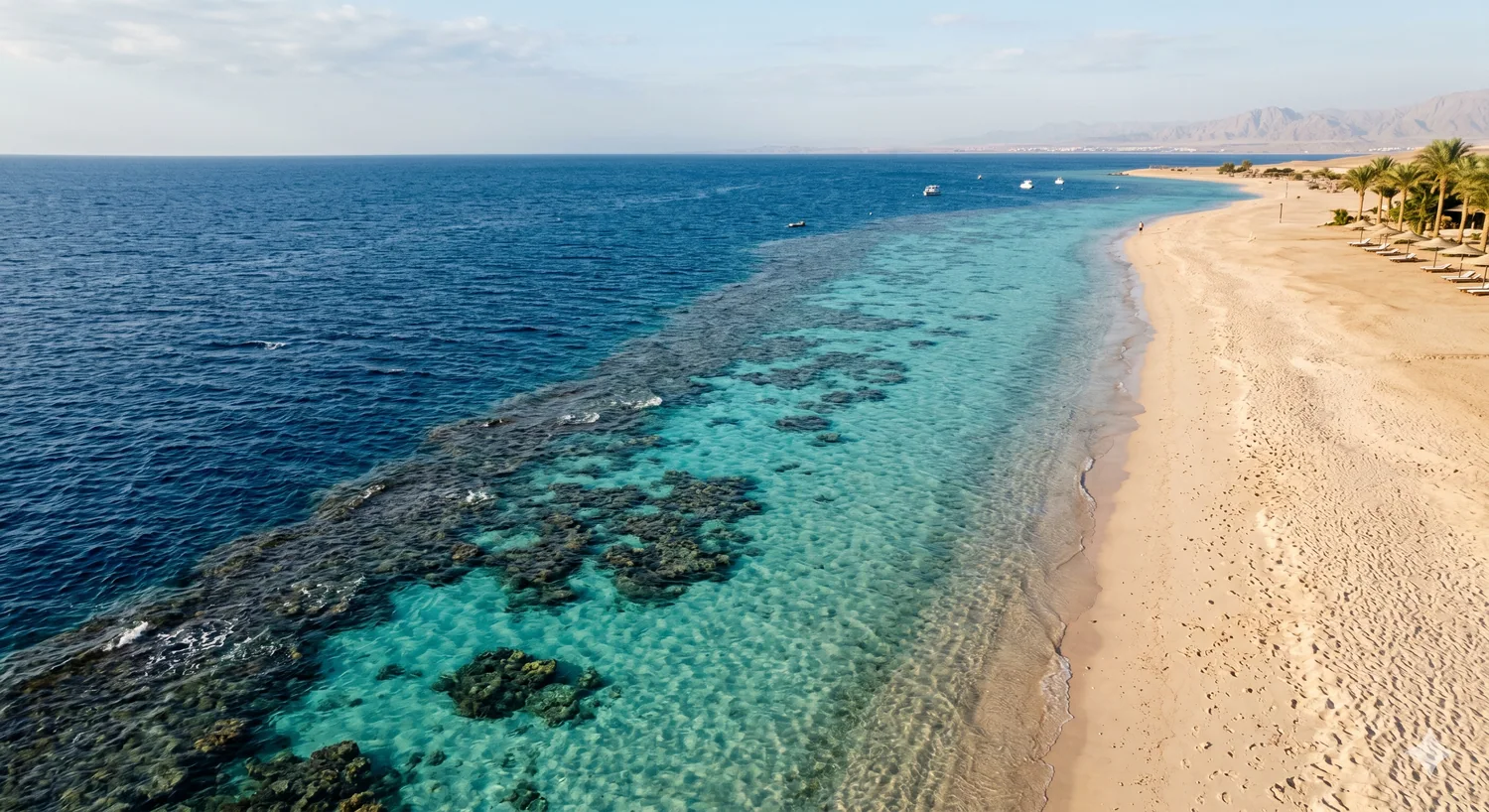
Nabq's reef, mangrove edge and the cargo wreck are all accessible from the shore. The water is home to dugongs on the seagrass beds, hawksbill and green turtles, giant moray eels and clownfish, with the reef in good condition thanks to the reserve's protection.
The sheltered water along the mangrove coast is ideal for kayaking. Paddling the tidal channels at high water is the quietest way to see the mangroves and their birdlife up close, without disturbing the shallows.
The mangroves and tidal flats draw grey herons, spoonbills, ospreys and steppe eagles, and Nabq sits on a major migration corridor. Spring and autumn bring large numbers of storks and raptors moving between Africa and Eurasia.
Behind the coast, the Nabq plain and the mountains beyond are open Bedouin country. Quad biking, camel treks and sandboarding on the dunes can be arranged locally, often combined with a visit to a Bedouin camp for tea.
With the reserve's low light pollution and dry desert air, the night sky over Nabq is exceptional. Camping overnight on the Munqatea beaches puts you under some of the darkest skies within easy reach of Sharm el-Sheikh.
Basic Bedouin-run camps and open beach sites make it possible to sleep inside the reserve, waking to the mangroves and the reef at first light. Trips are arranged in advance through local guides; this is a wilderness setup, not a serviced campground.
How to reach Nabq
Nabq is reached from Sharm el-Sheikh, roughly 35 kilometres and 40 minutes to the south. The protected area begins almost at the northern edge of Sharm el-Sheikh International Airport, and the main entrance is signposted off the coast road that runs north toward Dahab. A permit and a fee are payable at the gate. A 4x4 is recommended for the tracks inside the reserve, and most visitors come with a guide or on an organised day trip from Sharm. Dahab lies about 1.5 hours further north along the same coast road.
Keep reading, and open the whole Atlas.
A free account unlocks every dive site guide and map, the marine life library, member reports, and the full incident log. Free to join.
Join free to keep reading